
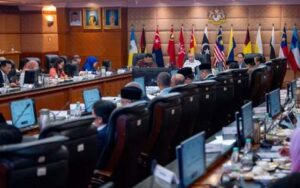
Photo: Ahmad Zahid Hamidi's Facebook Page, via Bernama
Momentum is building behind a longstanding idea in Southeast Asia's halal trade circles: a single ASEAN-wide body to harmonise halal standards across the region. Malaysia's Deputy Prime Minister, Datuk Seri Dr Ahmad Zahid Hamidi, who chairs the country's Halal Industry Development Council, confirmed this week that Malaysia intends to promote the establishment of an ASEAN Halal Council at the Malaysia International Halal Showcase (MIHAS), running from 23 to 26 September at the Malaysia International Trade and Exhibition Centre. Malaysia has proposed serving as the council's secretariat.
The push follows a meeting on 17 September in Jakarta between Zahid and Indonesian Vice President Gibran Rakabuming Raka, at which Gibran called for the council's establishment to be accelerated. Ahmad Haikal Hasan, head of Indonesia's Halal Product Assurance Agency (BPJPH), said afterwards that the vice president's support would "elevate our halal standards to the next level."
Ahead of a fuller ASEAN mechanism, Jakarta and Kuala Lumpur are working on a bilateral Indonesia-Malaysia Halal Council, which officials hope to complete before the end of the year. Under the arrangement, halal certification issued in one country would be automatically recognised in the other, removing a duplication that has long added cost and delay for exporters moving between the two markets. Officials have described the bilateral council as a stepping stone toward the wider ASEAN body, and eventually a World Halal Council; Malaysia has separately held talks with Saudi Arabia on a parallel World Halal Development Council that Riyadh would chair.For a region where halal certification standards have historically varied by country, sometimes significantly, a workable mutual recognition framework would mark a genuine shift rather than a symbolic one. Whether an ASEAN Halal Council actually takes shape on the timeline officials are describing, and how much authority it is given over national certification bodies such as Malaysia's JAKIM and Indonesia's BPJPH, is worth watching closely in the months ahead.
The timing is not incidental. Zahid is due to deliver the keynote address at the fifth Halal Summit in Jakarta, running from 18 to 20 September, days before MIHAS opens in Kuala Lumpur. For Indonesia, the push also feeds into President Prabowo Subianto's stated ambition of positioning the country as a global halal hub by 2029.
The economic weight behind the discussions is substantial. Malaysia's halal sector contributed RM81.25 billion to GDP as of 30 June this year, a rise of 6.1 per cent and equivalent to 7.6 per cent of total GDP, according to figures presented at the Halal Industry Development Council meeting. Halal exports for the same period reached RM33.29 billion, against RM68.52 billion for the whole of 2025, while cumulative investment in Malaysia's Halal Industrial Parks has reached RM13.73 billion.
For a region where halal certification standards have historically varied by country, sometimes significantly, a workable mutual recognition framework would mark a genuine shift rather than a symbolic one. Whether an ASEAN Halal Council actually takes shape on the timeline officials are describing, and how much authority it is given over national certification bodies such as Malaysia's JAKIM and Indonesia's BPJPH, is worth watching closely in the months ahead.
Halal Asia Network tracks halal industry and policy developments across ASEAN and the wider Asia-Pacific each day; subscribe to receive our latest news and the weekly roundup as soon as they are published.
