
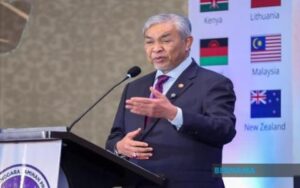
Photo: BERNAMA
Malaysia has put a specific date to its proposal for a regional halal body, with Deputy Prime Minister Datuk Seri Dr Ahmad Zahid Hamidi telling delegates in Jakarta that the ASEAN Halal Council should be formally established and launched in September 2027. Malaysia is prepared to serve as the council's secretariat, subject to the agreement of ASEAN member states, and has proposed Indonesia as the body's inaugural chair.
"Malaysia and Indonesia first put forward this idea last year. Today, I believe the time has come to move from discussion to institution," Zahid said in his keynote address at the fifth Halal 20 Summit in Jakarta on 18 September.
The council was first raised by Zahid during a Malaysia-Indonesia halal industry roundtable and a meeting with Indonesian Vice President Gibran Rakabuming Raka in Jakarta in April 2025, with the two countries agreeing the following month to jointly lead its formation. Zahid, who also chairs Malaysia's Halal Industry Development Council (MPIH), said the proposal has now been submitted to the ASEAN Secretariat and will next go before the ASEAN Summit in Manila for endorsement.
"Between now and then, we must put in place the council's mandate, governance and first deliverables so that it is ready to act from day one," he said, adding that the region's halal economy was expanding too quickly for ASEAN to organise itself at a slower pace.
Zahid framed the council as a step toward a broader World Halal Development Council, an idea he said would be discussed further at the Malaysia International Halal Showcase (MIHAS) in Kuala Lumpur later this month. On the wider halal economy, he cited figures showing global Muslim consumer spending across six key sectors reached USD2.6 trillion in 2024 and is projected to grow to around USD3.56 trillion by 2029, with halal food alone accounting for more than USD1.5 trillion of that spending.
"ASEAN is particularly well positioned to capture this growth. With more than 250 million halal consumers, we already have the scale, industries and capabilities to become a major force in the global halal economy," Zahid said, noting that inconsistent standards, certification and accreditation across member states still create friction and duplication for businesses operating across borders.
A firm launch date moves the proposal beyond the realm of aspiration, though the eleven months between now and September 2027 leave a great deal still to be settled, including how much authority the council would hold over national certification bodies such as Malaysia's JAKIM and Indonesia's BPJPH, and whether other ASEAN member states endorse Malaysia's bid to host the secretariat. Manila's response at the coming ASEAN Summit will be an early indicator of how much support the proposal carries beyond its two original sponsors.
Halal Asia Network tracks halal industry and policy developments across ASEAN and the wider Asia-Pacific each day; subscribe to receive our latest news and the weekly roundup as soon as they are published.
