
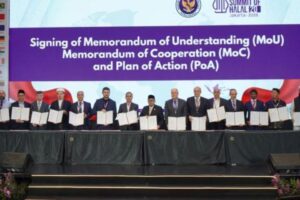
Photo: ANTARA/HO-BPJPH
Indonesia's halal authority signed 39 cooperation agreements on the opening day of the fifth Halal 20 (H20) Summit in Jakarta, among them 15 mutual recognition agreements with foreign halal certification bodies spanning four continents. The Halal Product Assurance Organising Agency (BPJPH) said the agreements, reached on 18 September, were aimed at strengthening the national and international halal assurance ecosystem.
"Cooperation results from H20 show that strengthening the halal ecosystem requires cross-country and cross-sector collaboration," said Abd. Syakur, BPJPH's Deputy for Halal Partnership and Standardisation, in a statement issued in Jakarta.
The 15 mutual recognition agreements were signed with certification bodies including Halal Australia, Halal Certification Services Switzerland, the Halal Certification Agency of Vietnam, Germany's IGMG-EHZ European Institute of Halal Certification, the Halal Food Council of Europe in Italy, Argentina's Centro Islámico de la República Argentina, Halal Correct Spain, the Halal Standard Committee of the Spiritual Board of Muslims of Tatarstan, Tunisia's Halal Science and Certification Center, New Zealand's THA New Zealand Limited, the Japan Halal Certification Promotion Organization, Portugal's Instituto Halal, Colombia's Fambras Certification, and the ANIC Halal Authority.
Separately, BPJPH signed four memoranda of understanding with strategic partners: South Korea's Ministry of Food and Drug Safety, Shanghai-based UniGlobal Trainbiz, Australia's Wagstaff Food Service, and Islam Channel Limited. A further 19 work-cooperation agreements were signed with domestic halal training institutions to build up certification workforce capacity, alongside a separate memorandum with PT Agri Tekno Karya.
Ahmad Haikal Hasan, head of BPJPH, told the summit that halal recognition was becoming a genuinely global vocabulary, extending well beyond food into cosmetics and pharmaceuticals, and said harmonising standards across the roughly 450 participants representing 48 countries at this year's summit remained the central challenge for the sector.
Mutual recognition agreements matter in practical terms because they let a product certified halal by one signatory body clear that bar automatically in the partner market, sparing exporters a second, often costly certification process. Fifteen new agreements in a single day is a large batch by past H20 standards, though the summit runs through 20 September and BPJPH has not said whether further signings are expected before it closes. As with any such agreement, how smoothly these translate into fewer border delays and lower compliance costs for exporters will depend on implementation on both sides, not the signing ceremony alone.
Halal Asia Network tracks halal industry and policy developments across ASEAN and the wider Asia-Pacific each day; subscribe to receive our latest news and the weekly roundup as soon as they are published.
